Napster: Innovator of the Music Scene in the 1990's
....Napster (about)...

Napster was a popular internet application developed in 1999 by Shawn Fanning and Sean Parker. With a peer-to-peer file sharing network, Napster was able to quickly build a large music file repository that could be accessed by anyone, practically anywhere, and free of charge. Downloading music in mp3 format could now be accomplished faster and in a much simpler manner with the organized user interface. Other users, who had the CD and used that to create an mp3 file on their computer, would then upload it to the server and give other users access to download that mp3 file on their own computer. Napster also had other functions besides being a site to download music files from. There was a chat function that allowed users to chat with each other in forums dedicated to different music genres. Napster also functioned as an mp3 player, helpful in cases where users didn’t have an external player on their computer. Hotlists were another feature of Napster that would allow users to keep track of their favorite libraries in case they wanted to browse them at another time.
Sampling music utilizing Napster helped users become acquainted with different artists and their tracks, so that they could later go and support artists they determined they were passionate about by buying their albums.
Fanning, who started thinking about creating Napster while an active member of various online communities, admitted that the idea for Napster was derived from the discussions held at the internet relay chat rooms(IRCs). Fanning’s roommate provided the idea for the problem that Napster was meant to address, as he often complained about the unreliable internet sites that were available at that time. Those sites had many broken links and outdated indexes. Fanning was receptive to working with others and developing the social aspect of the project, eventually partnering with Parker, another young programmer that he met through an IRC, to develop the beta versions of Napster.
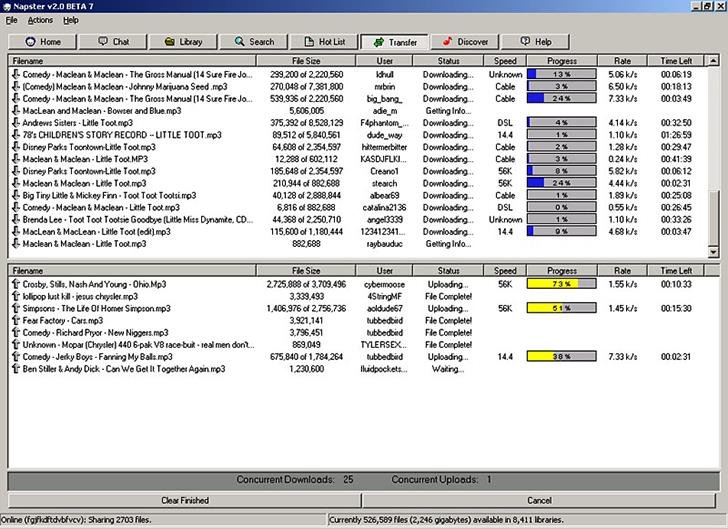
screenshot of Napster, with file transfer in progress
...Napster Userbase Details..

Napster had a special appeal among listeners of alternative music genres, such as hip-hop and indie rock. The “underground feel” of the program helped promote and distinguish Napster from similar programs. The fact that it was created by two young programmers helped fuel the image of the young “inventor-hero” that perpetuated the the most exciting projects on the internet are being developed by the youth and had a lot of potential to do great things.
Surveys conducted by various research organizations suggested that the majority of Napster users were adults between the ages of 25 and 49, and that more users of Napster would also be more likely to have several years of internet browsing experience. Despite this, court reports and subsequent articles by media outlets focused on the teen and young adult users in high school and university. These portrayals helped promote the narrative for increasing regulation of the youth on the internet, “pathologizing and criminalizing kids’ use of technology”.
....A Short Lived Platform....

The Recording Industry Association of America (RIAA) sued Napster for copyright infringement on December 8, 1999, just 6 months after it launched, asking for damages of $100,000 to be paid each time a song is copied.
Then, around February 2000, universities across the country started to ban Napster due to the fact that students would use it frequently for downloading and overwhelmed their computer systems with all the data being transferred. Some students responded to this ban by creating petitions online in hopes that administrators would remove the Napster ban.
On April 13, 2000, Metallica, a well-known American rock band, sued Napster for copyright infringement. Napster responded by removing approximately 300,000 users from its platform that downloaded Metallica songs.
On June 13, 2000, the RIAA continued the lawsuit and filed a “motion for a preliminary injunction” in order to block the trade of content through Napster. Napster hired David Boies two days later. Boies was well-known to be the lawyer that defeated Microsoft in the infamous antitrust case.
However, on July 26, 2000, U.S. District Judge Marilyn Patel ruled in favor of the record industry, requiring Napster to end the file transfer service of copyrighted material within two days.
Before the two days passed, an appeal was filed to the U.S. Court of Appeals for the Ninth Circuit. The Ninth Circuit agreed with the District Court and reiterated their commands for Napster’s compliance.
In October 2000, presidential candidate Al Gore even compared the American democracy to Napster, in which the “creativity and political imagination for all of our people” are able to be harnessed to work towards a fair and just system (Henig & Pontin, 2000).
Eventually, Napster failed to comply with the court regulations and was subsequently shut down in July 2001, just a little over two years since its launch.
.....Legal Troubles....

System administrators encountered many challenges with the rise of Napster. They could not implement “Filtering” since “individuals may readily access proxy servers” to download files. Port blocking was also not very useful as it is “readily outrun by spread-spectrum port number applications”. While they could revert to using antiquated protocols to “better prioritize packet delivery or banish packets by size altogether”, there are risks associated that businesses may lose important data. One potential fix implemented by a technician was to add a DNS entry for the website to block access from the business network, but it could be overcome if the employees were skilled in editing host files. Bandwidth expansion efforts became more imperative as the current limitations were made apparent by the increased use of Napster that is overloading networks with increased traffic.
Internet Service Providers (ISPs) that are responsible for public networks are also considering changing the structure of their networks as a response to platforms like Napster, such as by charging fees for bandwidth usage.
RIAA’s suit against Napster had plaintiffs “comprised of 18 affiliates from the five major record companies” and claimed to “speak for the interests of major artists and music retailers” (Spitz & Hunter, 2005).
The defense team for Napster argued that the system primarily functioned as an ISP, since it served to connect one client to another. As an ISP, it would be protected from “contributory copyright infringement liability” under the Digital Millenium Copyright Act (DMCA) as long as the program was intent to remove offenders. This argument was not accepted by the distinct court, especially as Napster failed to post its copyright compliancy policy online to notify users of repercussions upon infringement of the policy.
....Artist Responses....

Some artists regarded Napster as an “affront to the creative process” that undermined the creative effort and skill that distinguished them as artists with Napster making music “disposable” (Spitz & Hunter, 2005). Metallica’s Lars Ulrich, a major figure advocating against Napster, considered the program to be a “sign of the cultural degeneracy of the masses” in which their art pieces, music they create, is being treated as a commodity to be quickly consumed.
On the other hand, Napster, as well as the expansion of the Internet in the 90s, provided opportunities for unsigned artists to distribute their music and find an audience. The low transmission costs of circulating their art through the internet was an especially appealing benefit of the sites. In fact, 98% of all the artists on Napster did not belong to the labels that the plaintiffs belonged to.
A notable figure that instead advocated for the existence of Napster was recording artist Chuck D (leader of hip-hop group Public Enemy), who considered Napster a democratic medium due to allowing mainstream music to be distributed alongside that as created by emerging and undiscovered artists.
......Reflections and Impact on the Music Platforms of Today.....
Music streaming services of the modern internet age now quickly present songs, albums, artists at just the click of a button. This could be considered to have originated from the Napster search function, in which just the song title or artist name had to be entered to find different copies uploaded by other users. By allowing the user to select the songs they wanted to listen to instead of having to buy an entire album, music fans were able to save money and curate their playlists easily. The music industry’s wave of lawsuits against Napster ultimately failed to address the pertinent problem of allowing users to select specific tracks to buy and listen to. This was eventually addressed a couple of years later by the development of the iTunes Store by Steve Jobs. But in the span of those years, Napster inspired other providers, such as Gnutella and Limewire, to adopt the model and continue to serve users seeking a better platform to listen to music. Platforms such as Youtube, Spotify, and iTunes, which allow the music industry to profit off a streaming system, use the core innovation that Napster introduced, in which users can consume the music they want to via the internet.

screenshot of Napster's search window'
..Research References..

https://www.bbc.com/culture/article/20190531-napster-turns-20-how-it-changed-the-music-industry
https://web.archive.org/web/20110222201408/http://www.isp-planet.com/politics/napster.html
Spitz, D., & Hunter, S. (2005). Contested Codes: The Social Construction of Napster. Information Society, 21(3), 169–180. https://doi-org.ezproxy.gl.iit.edu/10.1080/01972240490951890
Woodworth, G. M. (2004). Hackers, Users, and Suits: Napster and Representations of Identity. Popular Music & Society, 27(2), 161–184. https://doi-org.ezproxy.gl.iit.edu/10.1080/03007760410001685813